A Wireless Story for Notre Dame Day
(Originally published for Notre Dame Day 2023.)
For Notre Dame Day 2023, I wanted to share with you the story behind the story of how Notre Dame came to develop its Wireless Institute in the College of Engineering, and to lead SpectrumX, the NSF Spectrum Innovation Center. If this story moves you to support our mission, we welcome your donations.
It all started in 1899…(dramatic pause)…. A Notre Dame electrical engineering professor named Jerome Green created the first long-distance wireless transmission in North America. He apparently had heard of Marconi’s wireless experiments, designed his own radio transmitter and receiver, and somehow convinced the University leadership to install an antenna on the Basilica for a transmission to nearby Saint Mary’s College. So we will be celebrating 125 years of wireless at Notre Dame in 2024!
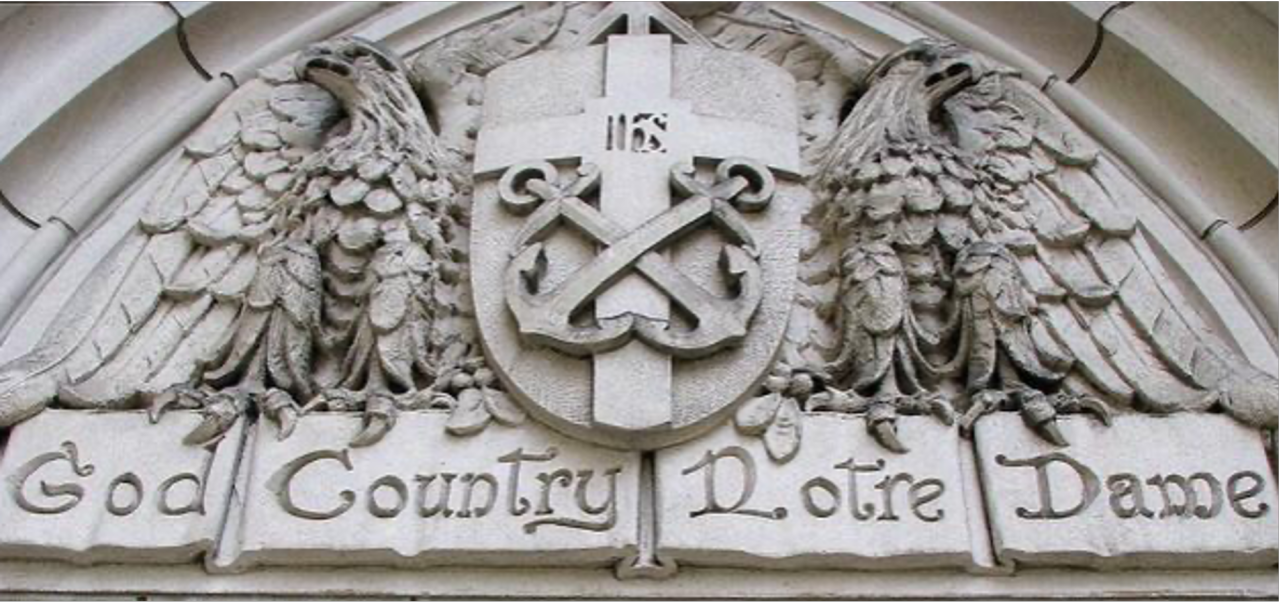
Speaking of our Basilica, there is a stone inscription above the side entrance door that says, “God, Country, Notre Dame.” This inscription honors the 56 men from Notre Dame who gave their lives in World War I. The phrase is a memorable one in the Notre Dame lexicon, and captures the spirit of civic service that permeates the University.
“God, Country, Notre Dame” is also the title of the autobiography written by the late Father Theodore Hesburgh, who was President of Notre Dame from 1952 to 1987. He did tremendous things to help Notre Dame develop in his 35 years as President. As a new junior faculty member in 2002, I had the good fortune to meet Fr. Ted, as he is affectionately known. He signed my copy of his book, which I read all the more enthusiastically to learn more about him, the University, and the Notre Dame family that I had just joined.
One of the more inspiring stories of Fr. Ted’s life is his involvement in Civil Rights. He once joined Dr. Martin Luther King Jr. on short notice at a civil rights rally in Chicago, and they were captured holding hands and singing in solidarity in a now famous photograph. Fr. Ted then served on the Civil Rights Commission from its inception in 1957 until 1972, and is acknowledged as the principal architect of the Civil Rights Act of 1964. He famously took the Commission fishing at Notre Dame’s research site in Wisconsin, Land O’Lakes, which helped them relax and bond as a group, contributing to a strong consensus on their recommendations. That’s an idea for us to remember for future spectrum conflicts….
I have always found Fr. Ted’s life and work at Notre Dame inspiring, and have looked for opportunities to follow his example in my own way. Radio spectrum conflicts fascinated me, and I found that the issues were about much more than technology research and innovation. I came to believe that Notre Dame could, and should, develop a distinctive presence in this space. With significant encouragement and support from the Department of Electrical Engineering, the College of Engineering, and the Office of Research, we created the Wireless Institute at Notre Dame in January 2010. I already had fantastic colleagues at the time, including Dan Costello, Tom Fuja, Martin Haenggi, Yih-Fang Huang, Tom Pratt, and Aaron Striegel. We have since recruited Bert Hochwald, Jon Chisum, and most recently Monisha Ghosh to join both Electrical Engineering and the Wireless Institute, to expand our expertise and capabilities. We created the first NSF Industry/University Cooperative Research Center at Notre Dame in 2014, and we launched the RadioHound spectrum sensing project. We prototyped dynamic spectrum access algorithms in the context of the WiFi and LTE standards, and we developed new hands-on courseware to make these technologies and issues more accessible to our students. All of these activities and collaborations prepared us to pursue the NSF Spectrum Innovation Initiative Center, and ultimately win the SpectrumX award.
The bottom line, at least for me, is that following in the footsteps of Jerome Green and Fr. Ted, we had to go big. And hopefully through the SpectrumX center we can make a difference and live out Notre Dame’s mission to be a Force for Good, at least in the radio spectrum ecosystem here in the US. We have so many more opportunities and relationships through which to prepare our students for successful careers in this field, which has become one of the foundations of modern society.
So that is the story behind the story of Notre Dame’s role in SpectrumX. It has been a defining passion project of my career, and I am so grateful to have the opportunity to serve and collaborate with so many incredible colleagues and students over the years.