Five Years of SpectrumX: What We Built and Why It Matters
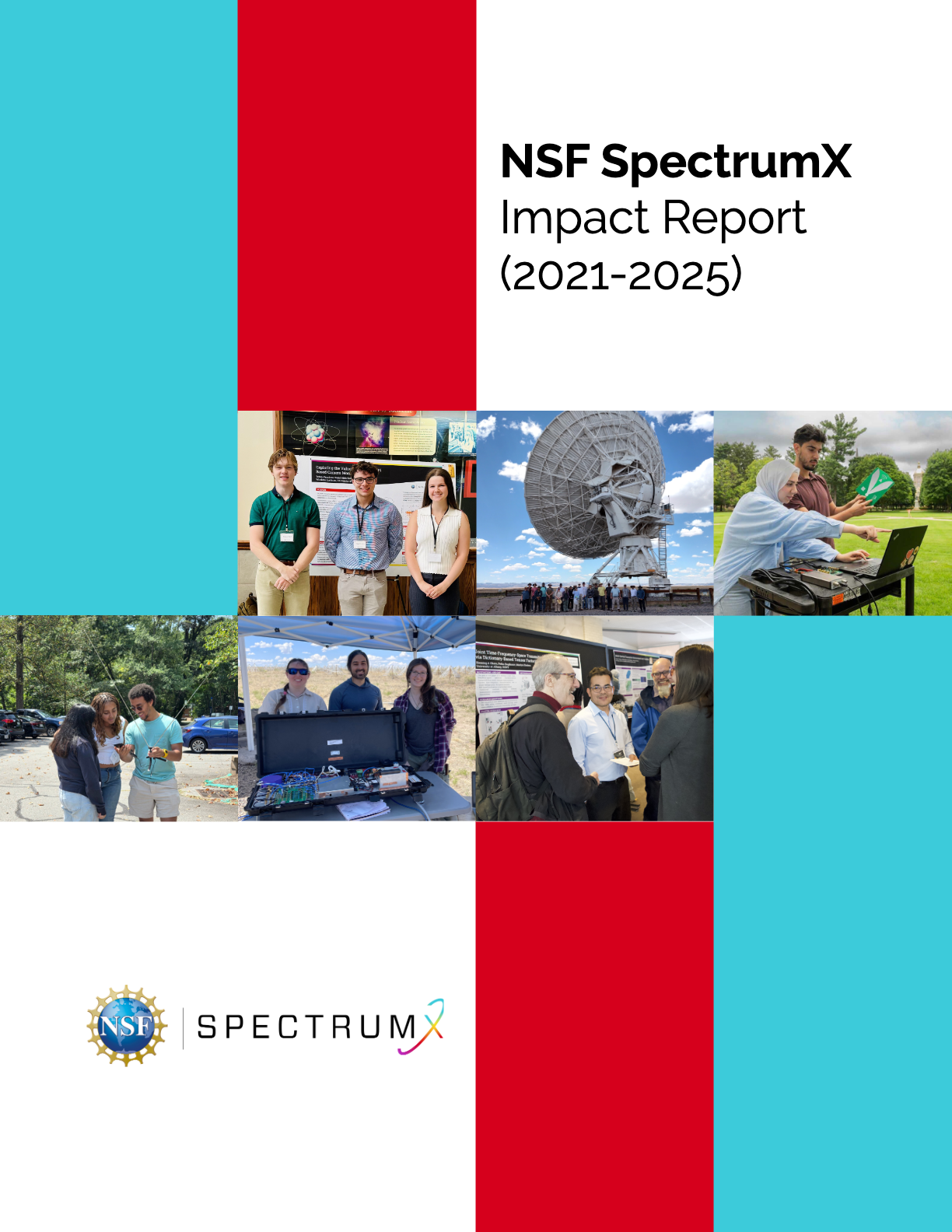
Five years ago, we collectively asked a visionary question: what would it look like if the U.S. radio spectrum ecosystem had a large academic hub — a national center — that engaged a broad cross-section of scientists, engineers, economists, lawyers, policymakers, and students, as well as corporations, agencies, and non-profits? A place where they could all convene, collaborate, and collectively move the needle on some of the hardest problems in modern spectrum access and management, as well as workforce development?
The NSF SpectrumX Impact Report, which we released in May 2026, is our answer to those questions — at least our answer to date.
–
The breadth and depth of what our Center has built is remarkable.
Organizationally, we have over 25 university partners and 20 collaborating organizations, with the ability to add individual researchers and member institutions to fill gaps in expertise and facilities as needed. We are built to scale and adapt.
In translational research, we have pursued work that no single university or smaller team could take on. Our two Flagship Projects — one focused on spectrum awareness and enabling AI/ML, the other on coexistence with LEO satellites — have brought together coordinated, multi-institutional teams with over 30 researchers and 45 graduate students working toward outcomes with direct policy relevance. These aren’t incremental contributions. They include development of shared measurement and data platforms, large-scale field experiments at world-class facilities like MIT Haystack and the NRAO Very Large Array, and an international student data competition. We’ve built open-source hardware, open data repositories, and shared measurement infrastructure that the broader community can continue to leverage long after our initial grant period ends.
The Flagship Projects pull innovations from our Seed Projects and Research Community discussions, which allow us to be much more adaptive than typical funding cycles. Our Liaison Projects, initiated with NTIA but available to all government and industry partners, draw on our wide array of expertise and capabilities to address specific topics and problems of interest to them.
Through all of these activities, we’ve produced over 300 publications across conferences and journals, and won a series of paper awards at conferences like IEEE DySPAN and URSI NRSM.
And the workforce multiplier effect of this model is extraordinary. With over 175 participants — students, faculty, and staff — drawn from over 25 colleges and universities, spanning engineering, economics, law, and public policy, NSF SpectrumX doesn’t just conduct research. It prepares the next generation of spectrum leaders. Through Summer Schools, Research Experiences for Undergraduates (REU) programs, K-12 lesson plans, and higher-education online courseware reaching thousands of learners, we’re building pathways into the spectrum workforce at every educational level.
We’ve also been a convener in the truest sense. From NSF Spectrum Week — which brought together 450 participants in 2024 alone — to our biannual Center Meetings, Radio Shop Chats, workshops, and field experiments, NSF SpectrumX has consistently created space for the spectrum community to think together, debate constructively, and build shared understanding.
And we’ve brought that shared understanding directly to policymakers by tracking regulatory proceedings, submitting research-based regulatory comments, serving as objective panelists in numerous policy symposia, and even Congressional testimony.
When I set out on this journey, I had a strong sense that we could build something significant. What I didn’t fully anticipate is how profoundly this Center would reshape my own sense of vocation as a professor and resonate with Notre Dame’s mission. SpectrumX provides a very tangible means — for me, and for so many of us — to focus technical expertise, research results, and student training to directly benefit society, and to develop into the role of a citizen scientist. That evolution is something I carry with deep gratitude, and energizes me to foster the same growth opportunity for others.
What we have built together is not just a successful five-year project. It is a strategic national asset — and we are working hard to evolve it and sustain it. The infrastructure, the relationships, the capabilities, the credibility, the talent pipeline — these don’t exist anywhere else in the world. We believe this Center can significantly contribute to U.S. competitiveness in wireless technology and spectrum policy, for national and economic security, and for the thousands of students whose educations are just beginning.
The spectrum challenges ahead — from satellite constellations to 6G to drones to AI-driven sharing — are only growing in complexity and consequence. They require exactly what SpectrumX has demonstrated it can deliver: objective, interdisciplinary, policy-relevant research at the national scale.